


Origins: the Advanced Tactical Fighter (ATF) program
The Raptor’s story goes back to the 1980s, when the U.S. Department of Defense and the United States Air Force (USAF) announced a requirement for a new tactical fighter. The goal of the Advanced Tactical Fighter (ATF) program was to create a successor to the legendary F-15 Eagle, capable of penetrating Soviet airspace and defeating the then-modern Su-27 and MiG-29 fighters.
Two teams entered the competition for the contract of the century. The first, led by Lockheed Martin (supported by Boeing and General Dynamics), presented the YF-22 prototype. The second, created by Northrop and McDonnell Douglas, unveiled the futuristic YF-23. Ultimately, due to better maneuverability and lower technological risk, Lockheed’s design won and, after refinement, entered service as the F-22A Raptor.
Technology and dominance
The F-22 is an advanced air superiority fighter whose primary mission is to secure control of the skies, though it also has the capability to strike ground targets and conduct electronic warfare and electronic surveillance.
Key innovations:
-
Stealth technology: the airframe’s shaping and special coatings make the aircraft extremely difficult to detect by an enemy radar. The Raptor’s radar signature is often compared to the size of a metal marble, enabling it to attack the enemy before they even realize there is a threat.
-
Supercruise: thanks to powerful Pratt & Whitney F119 engines, the F-22 reaches supersonic speed (about Mach 1.8) without using afterburners. This provides a huge energy advantage over aircraft such as the F-16 or F-18, while saving fuel at the same time.
-
Thrust vectoring: the engine nozzles are movable in the vertical plane. This allows maneuvers impossible for other aircraft, providing a decisive advantage in close-in air combat.
Service in the U.S. Air Force and exclusivity
The F-22 Raptor is so advanced that the U.S. Congress imposed a complete ban on its export. The United States is the sole operator of this aircraft type. Even the closest allies, such as Israel or Japan, had to make do with the newer but lighter F-35 Lightning II.
Although the Raptor was designed to fight the Soviet Air Force, its combat debut did not occur until 2014 over Syria, as part of operations against the Islamic State, where it served as a strike and command platform (a "quarterback" on the battlefield). In 2023, the F-22 made headlines by shooting down a Chinese spy balloon over U.S. territory using an AIM-9X missile.
Modeling and display potential
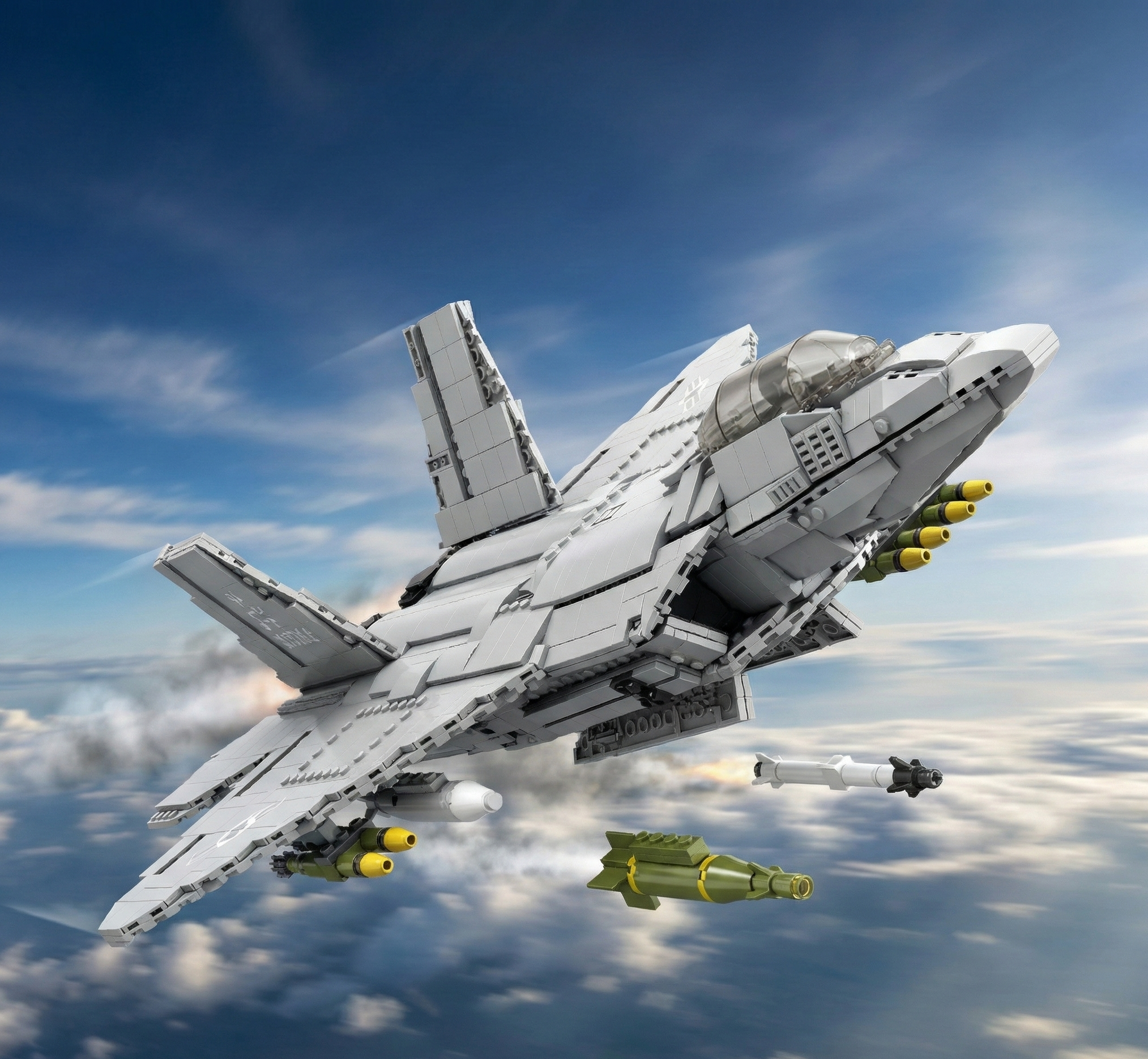
For aviation and construction-brick enthusiasts, the F-22 is the "Holy Grail" of a collection. Its futuristic silhouette, sharp angles, and aggressive look have been perfectly captured in the model available in Reobrix’s lineup.
Recommended product: The impressive F-22 Fighter Raptor (Reobrix 33020) model is a premium-class set consisting of as many as 1729 pieces.
-
Scale and details: The model faithfully reproduces the geometry of a stealth airframe, movable control surfaces, and armament hidden in internal bays (a hallmark of 5th-generation aircraft, unlike the F-15 or F-14 Tomcat, which carry weapons externally).
-
Dimensions: The finished aircraft makes a substantial display piece, ideal for a desk or a collector’s shelf.
-
Who it’s for: The set is an excellent challenge for military technology fans who want to build their own U.S. Air Force squadron.
Build an aviation legend and feel the power of stealth technology in your home.
More in the category: Combat aircraft
 Log in with Facebook
 Log in with Google