


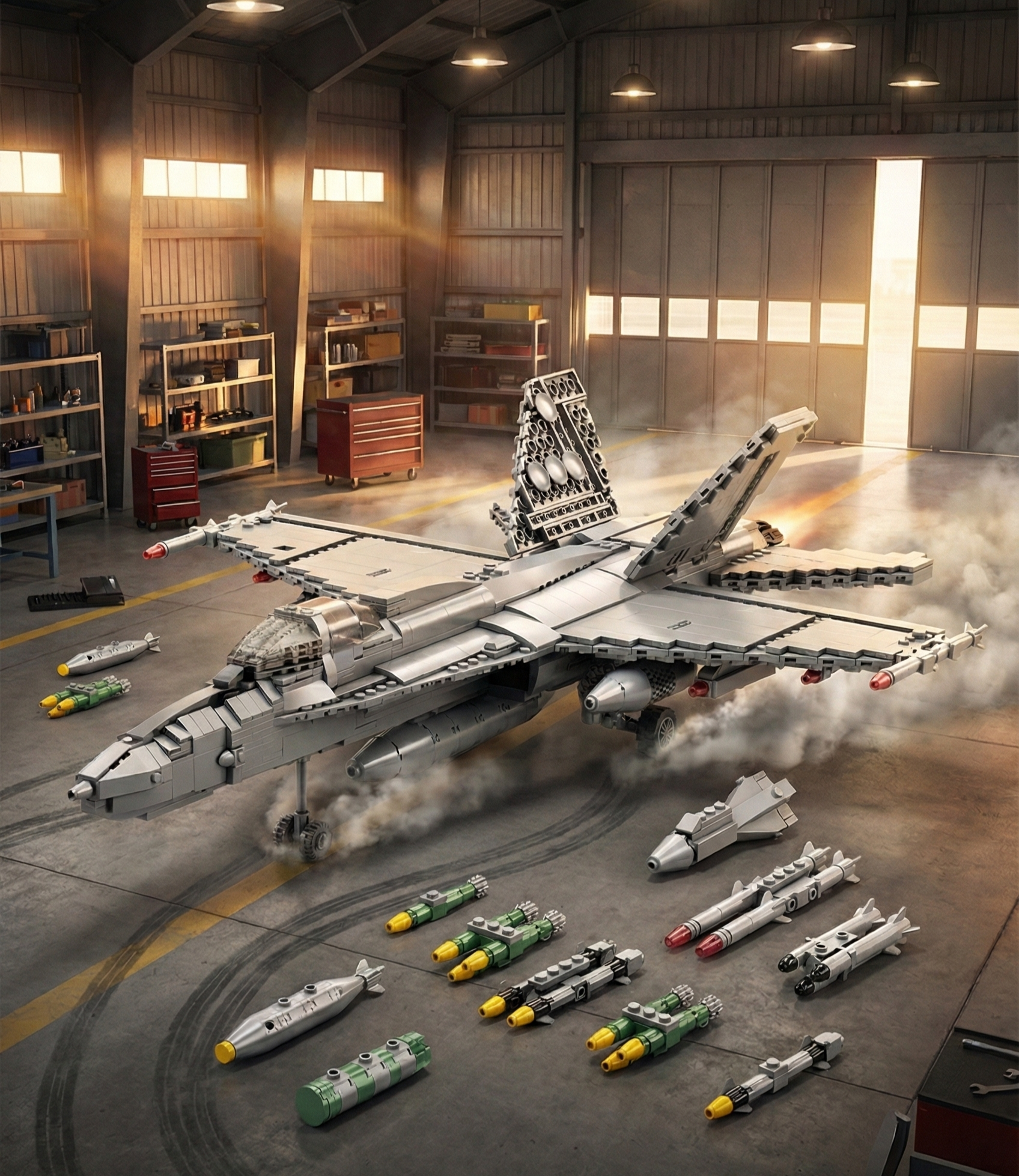
In the 1990s, the airframe underwent a major redesign, resulting in the much larger Super Hornet. After Boeing acquired McDonnell Douglas in 1997, it is Boeing that has been responsible for the production, development, and modernization of the entire Super Hornet fleet and its electronic-warfare variant. Boeing has delivered hundreds of these aircraft, which—after the retirement of the legendary F-14 Tomcat in 2006 and the attack A-6 Intruder—became the only type of combat aircraft aboard U.S. aircraft carriers (until the arrival of the F-35C).
Carrier-based multirole aircraft (Multirole Carrier-based Aircraft).
The unique "F/A" designation (Fighter/Attack), assigned upon entry into service, revolutionized U.S. Navy doctrine. For the first time, a single aircraft type was just as effective in air-to-air combat as it was at precision strikes against ground and sea targets during the same mission. Hornets are adapted for extremely demanding operations from an aircraft carrier deck (CATOBAR system), which requires powerful catapult launches and brutal landings using an arresting hook. The family is divided into two generations:
"Legacy" Hornet (F/A-18A/B/C/D): Smaller, lighter aircraft, currently being phased out of the U.S. Navy, but still forming the backbone of U.S. Marine Corps (USMC) aviation and many allied nations.
Super Hornet (F/A-18E/F): Significantly larger, more modern aircraft with greater range and payload. The 'E' version is single-seat, and the 'F' is two-seat, often used for missions that require a weapons systems operator.
EA-18G Growler: A specialized Super Hornet variant (based on the F/A-18F airframe) intended for electronic warfare. Its mission is to jam enemy radars and air-defense systems, providing a "protective umbrella" for strike groups.
The main and largest operator is the U.S. Navy (US Navy), which flies only Super Hornets and Growlers, as well as the U.S. Marines, who still use older C/D versions (while awaiting full re-equipment with the F-35B/C). The Hornet has also proven to be a huge export success, valued for its reliability (two engines are critical for flight safety over the sea) and versatility. Operators include:
Canada and Australia: Long-time operators modernizing their fleets (Australia also purchased Super Hornets and Growlers as a bridge to the F-35).
Spain, Finland, Switzerland: European countries that selected the Hornet as their primary multirole fighter. In recent years, Finland and Switzerland decided that the successor to their Hornets will be the F-35, but the process will take years.
The F/A-18 is among the hardest-working combat aircraft in the world. Its combat debut took place during operations over Libya in 1986 (Operation El Dorado Canyon). The real test was Desert Storm (1991), where Hornets proved their multirole capability by shooting down Iraqi MiGs and bombing ground targets on a single mission. They then took part in the wars in the Balkans, formed the backbone of strike forces during Enduring Freedom in Afghanistan and Iraqi Freedom in Iraq, dropping thousands of tons of precision bombs and providing close air support to ground troops. They were key in the intervention in Libya (2011) and in ongoing operations against ISIS and other terrorist groups in the Middle East.
Key parameters and evolution (Super Hornet Block III)
- The Super Hornet, despite its visual similarity, is about 25% larger than the classic Hornet. It has 33% more internal fuel, 41% greater range, and more powerful General Electric F414 engines. Its air intakes are rectangular (as opposed to the rounded ones on older versions), which helps reduce its radar signature.
- Durability: The reinforced landing gear and airframe structure are designed to withstand thousands of brutal carrier landings, making it one of the most rugged aircraft in the world.
- Block III modernization: The latest standard that the U.S. Navy has received in recent years ensures that Super Hornets will remain in service well beyond 2030, serving as a complement to the F-35C.
The Block III version includes:
-
Conformal fuel tanks (CFT): Mounted along the spine of the fuselage, they increase range without taking up weapon stations or increasing drag.
-
Advanced cockpit: Replacing many analog gauges with a single large touchscreen display.
-
AESA radar and network centricity: A powerful active electronically scanned array radar and systems enabling real-time data exchange with the F-35 and ships (sensor fusion).
-
Extended service life: Structural reinforcement allowing up to 10,000 flight hours
Thanks to its ubiquity in the media and pop culture (including a leading role in the film "Top Gun: Maverick"), the distinctive silhouette of the "Hornet" with its canted vertical stabilizers is an icon of naval aviation. The brick set F-18 Strike Fighter Hornet (Reobrix 33022) is a treat for "Top Gun" fans and military-technology enthusiasts. The model, made up of 1387 pieces, allows you to build a detailed replica of this combat aircraft, featuring its massive landing gear, folding wingtips (a characteristic of carrier-based aircraft), and a rich set of external stores.
Feel like a Navy pilot—choose a model and order it here: Combat aircraft
 Log in with Facebook
 Log in with Google