


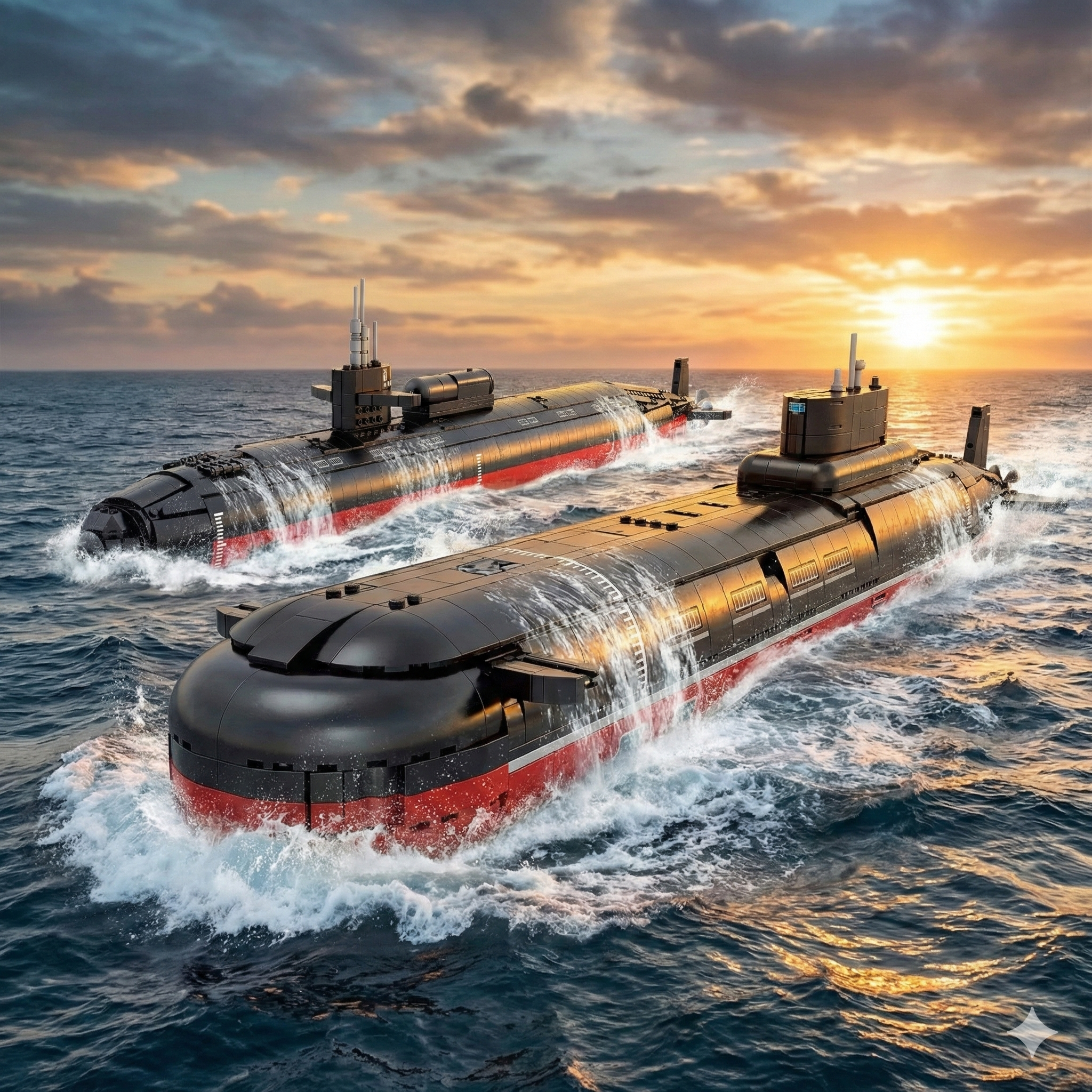
Tactics: the hunter and the destroyer of worlds
Both submarines, although nuclear-powered, were created for completely different purposes. Understanding their tactics makes it possible to appreciate the differences in the look of the Reobrix models.
-
Los Angeles Class (SSN - Hunter): This is a classic “Hunter-Killer.” Its mission is to be fast, agile, and undetectable. The tactics of these units revolve around tracking enemy submarines, protecting their own carrier strike groups, and carrying out precision Tomahawk missile strikes against land targets. They are the new era’s “wolves” — operating in silence, seeking contact with the enemy.
-
Shark 941 / Typhoon (SSBN - Destroyer): This colossus was not meant to search for the enemy — it was meant to hide from it. Built under the “Bastion” doctrine, the Typhoon was so enormous because it had to carry gigantic ballistic missiles capable of reaching the USA from the USSR’s territorial waters. Its tactics relied on sailing under the Arctic ice, breaking through the ice pack with the hull and (in an ultimate scenario) launching a nuclear salvo. It is a mobile base whose only goal is to survive until the order is received.
Service on a nuclear submarine means months without sunlight, in complete isolation. However, the conditions on these two units differed dramatically.
-
American pragmatism (Los Angeles): Space is a luxury. Every cubic centimeter of a Los Angeles-class submarine is filled with equipment. The passageways are narrow, and on older boats so-called “hot bunking” was used — three sailors shared two bunks, sleeping in shifts. Life here runs to an 18-hour day, governed by watches and equipment maintenance.
-
Soviet comfort (Shark/Typhoon): Due to its monstrous size, the Typhoon offered the crew conditions unseen anywhere else. Sailors called it the “floating Hilton.” On board there was a small gym, a wood-lined sauna, and even (according to some accounts) a small pool and a relaxation area with an aviary. This was crucial for the crew’s mental well-being during long patrols under the Arctic ice.
Construction details: what’s inside the bricks?
When you build these models, you’ll notice fundamental differences in engineering that Reobrix has faithfully reproduced.
-
Hull shape: The Los Angeles model (Reobrix 33049) has the classic cigar-shaped (“teardrop”) form, optimized for hydrodynamics and underwater speed.
-
Internal structure: The Shark 941 (Reobrix 33048) is unique. In reality, inside the large light (outer) hull are hidden two parallel pressure hulls (like two smaller submarines side by side) as well as separate control and torpedo modules. It’s this “catamaran” construction that gives it such a wide, flat silhouette, which is clearly visible in the model.
Both sets are advanced “Technic/Display” type projects, intended for older builders and military memorabilia collectors. These are not simple toys, but detailed scale models.
Nuclear submarine Shark 941 (Reobrix 33048)
-
Number of pieces: 2895
-
Features: The model dominates with its mass. Its broad hull and distinctive sail (tower) convey the power of the original. The designers took care to reproduce the missile launchers (silos) placed in front of the sail, which is a unique feature of the Typhoons.
-
Difficulty level: High. The frame construction requires attention to maintain the shape of this giant.
Nuclear submarine Los Angeles Class (Reobrix 33049)
-
Number of pieces: 2750
-
Features: The model is sleek and long. Details focus on the diving planes (mounted on the sail, which is typical for this class) and the propulsion (shrouded propeller). The smooth finish of the sides made from bricks is meant to imitate the anechoic coating (sound-dampening) used on real submarines.
-
Realism: Very high. The proportions between length and width have been preserved, making the model look extremely dynamic.
Verdict
Choosing between these sets is choosing between two philosophies. Do you prefer the Los Angeles — a symbol of precision, speed, and American dominance at sea? Or perhaps the Shark (Typhoon) — a symbol of raw Soviet power and engineering ambition that didn’t count the costs?
For a complete picture of Cold War history, these two models look best side by side on a shelf, showing the scale of the arms race in miniature.
 Log in with Facebook
 Log in with Google